
Salt mine
Speleotherapy
Family-friendly
Cacica
One of the oldest salt works in Europe — salty underground air for the respiratory tract, with a chapel carved in salt and an underground salt lake, stable all year round.
At a glance
Cacica lies in Suceava County, in the Bukovina region of northern Romania. The Salina Cacica is one of the oldest salt works in Europe — brine was already boiled into salt here in the 5th millennium BC; under Austrian administration, prospecting began from 1783 and professional mining from 1791. Underground there is a constant microclimate with salty, ion-rich air, traditionally recommended for chronic respiratory conditions. Its highlights include the St Barbara chapel carved entirely in salt, a hand-dug underground salt lake and a ballroom.
Well suited for
- Respiratory tract (asthma, bronchitis, allergies)
- Culture & monastery trips (Bukovina)
- Year-round stays
Less suited for
- Acute infections & fever
- Those seeking classic thermal bathing
01Overview & history
Cacica lies in Suceava County, in the Bukovina region of northern Romania. The Salina Cacica is one of the oldest salt works in Europe: brine was already boiled into salt here in the 5th millennium BC. Under Austrian administration, prospecting began from 1783 and professional mining from 1791; the walkable galleries reach ~40 m, the mine itself down to ~70 m.
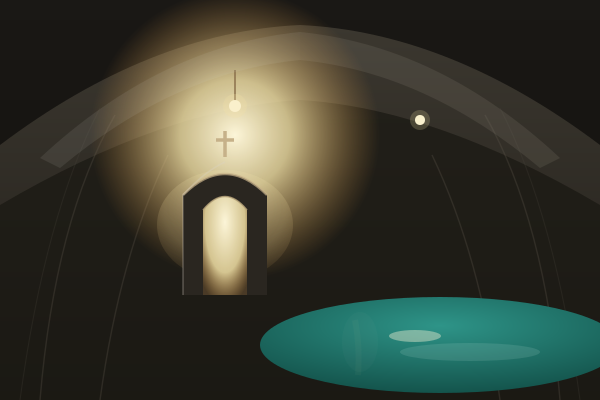
Underground highlights include the Roman Catholic St Barbara chapel carved entirely in salt (at about 29 m depth), a hand-dug underground salt lake (approx. 40 m deep, roughly 10 × 6 m, with salt crystals on its walls) and a historic ballroom. Above ground, a small Polish community with its pilgrimage church, and the proximity to Bukovina's painted monasteries, give the village its character.
02Remedy & composition
Cacica's central remedy is the salty, ion-rich underground air (speleo- or halotherapy): a constant, low-dust microclimate free of strong air currents, carrying salt aerosols of sodium and chlorine. The climate is considered mucus-clearing and soothing to the airways; the effect relies on calm, even breathing in the salty air.
| Property | Detail |
|---|---|
| Remedy | Salty underground air (speleotherapy) |
| Underground temperature | approx. 10–12 °C, constant year-round |
| Air environment | Low-dust, salty, free of strong air currents |
| Salt aerosols | Rich in sodium and chlorine |
| Gallery depth | walkable galleries reach ~40 m, the mine itself down to ~70 m |
Figures are for orientation only. Exact climate and analytical values vary by gallery and facility.
03Indications & contraindications
Traditionally recommended for
- Chronic respiratory conditions (bronchial asthma)
- Chronic bronchitis
- Allergies & recurring respiratory infections
- Rhinitis & sinusitis
Caution / seek medical advice with
- acute infections
- fever
- severe cardiovascular disease
- unstable asthma
04Spa treatments
| Treatment | Description | Duration |
|---|---|---|
| Speleotherapy | Time spent in the salty underground air | 2–4 hrs |
| Rest & breathing time | Calm resting and breathing in the salt galleries | 30–60 min |
| Underground walk | Walking through galleries, chapel & salt lake | individual |
| Sightseeing | St Barbara chapel, salt lake & ballroom | individual |
| Medical consultation | On request in the region's spa towns | individual |
05Accommodation
In Cacica and the surrounding Bukovina villages there are pensions, guesthouses and agritourism stays. For a wider choice, the nearby county town of Suceava or the monastery area around Gura Humorului are good bases — ideal starting points for trips to the painted monasteries.
Guesthouses & pensionsFamily-run, rural, close to the mine

Gura Humorului monastery areaWider choice, ideal for excursions
Specific accommodation with prices and booking links to follow shortly.
06Prices & opening hours (guide)
| Service | Guide price |
|---|---|
| Day ticket, salt mine | from approx. €4–9 |
| Reduced (children / seniors) | from approx. €2–5 |
| Photo permit (optional) | from approx. €1–3 |
| Guesthouse overnight (double room) | approx. €30–60 / night |
Guide prices, as of 2026. Prices and opening hours vary by season and facility — please confirm on site.
07Nearby
- Bukovina's painted monasteries — Voroneț, Humor & Moldovița, a UNESCO World Heritage Site
- Polish pilgrimage church — a testament to Cacica's historic Polish community
- Suceava (~40 km) — fortress and museums at the heart of Bukovina
08FAQ
What is speleotherapy in Cacica?
Speleotherapy means spending time in the salty, ion-rich underground air of the salt mine. The constant microclimate is traditionally recommended for chronic respiratory conditions; the effect relies on calm breathing in the low-dust, salty air.
When is the best time to visit?
Year-round, as the mine's underground climate stays constant. The microclimate is stable regardless of the season.
How far is the nearest airport?
Suceava Airport (Salcea, SCV) is about 40 km away. From there, Bukovina's painted monasteries make comfortable day trips.
What can you see underground in Cacica?
The St Barbara chapel carved entirely in salt at about 29 m depth, a hand-dug underground salt lake (approx. 40 m deep) with salt crystals on its walls, and a historic ballroom; the walkable galleries reach ~40 m, the mine itself down to ~70 m.
Similar spas
You might also like