
Bihor County
Băile Felix
Year-round warm thermal water — Romania's largest thermal spa for rheumatism and joint cures.
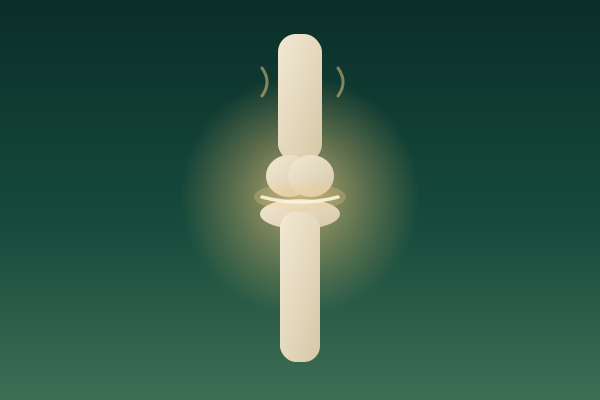
How thermal water, healing mud and exercise therapy in Romania's spas are traditionally used for joint wear.
By the Terra Cura editorial team · Last updated: August 2026
Health notice
This article offers editorial health and travel information and is no substitute for medical advice, diagnosis or treatment. Osteoarthritis should always be assessed by a doctor — coordinate every cure and every treatment with your doctor beforehand.
Osteoarthritis is the most common joint disease and refers to the progressive wear of the joint cartilage. As the protective cartilage thins, the joint surfaces rub together more — causing pain, stiffness and restricted mobility. The knees, hips, hands and spine are particularly affected.
Typical is the start-up pain after periods of rest, which initially eases with movement. Osteoarthritis cannot be cured, yet the symptoms can be relieved and the course can be influenced positively — among other things through warmth, movement and gentle, joint-relieving therapies of the kind traditionally offered at healing spas.
Balneological cures are traditionally recommended for osteoarthritis because they work on several fronts at once — warming, relieving and encouraging movement:
The effect is above all a physical one. Thermal water is usually brought to a thermoneutral 32–36 °C, at which the body neither has to warm up nor cool down: the muscles that guard a worn joint relax, pain signalling settles and range of movement improves. In the pool, buoyancy offloads much of the body's weight, so a knee or hip that hurts on land can be moved almost freely — the basis of underwater exercise therapy. At the same time the water's hydrostatic pressure gently supports the tissue and can help reduce swelling.
Peloids — Romania's sapropelic (organic) muds and mineral silts — hold heat far longer than water and release it slowly into the tissue, producing a deep, even warmth exactly where a pack is applied. Sulphurous thermal water, as at Băile Herculane, adds hydrogen sulphide that is absorbed through the skin and is traditionally credited with an anti-inflammatory, cartilage-supporting effect, though the clinical evidence for this remains limited.
Balneotherapy has a long tradition, but the modern research base is modest and should be read honestly. A Cochrane systematic review of spa therapy for osteoarthritis found that mineral baths may improve pain and quality of life compared with no treatment — yet the authors rated the overall evidence as weak, because the trials were small and methodologically limited. A more recent systematic review (2023) reached a similar conclusion: mud-pack and mineral-water cures can offer short-term relief of pain and stiffness, while high-quality, long-term data are still lacking.
In plain terms: a cure may ease symptoms and support mobility for a period of weeks to months, but it is best understood as a complement to — never a replacement for — evidence-based osteoarthritis care such as regular exercise, weight management and the treatment your doctor recommends.
| Treatment | Purpose | Duration |
|---|---|---|
| Thermal bath | Warmth & buoyancy relieve and loosen the joints | 20–30 min |
| Mud/silt pack | Deep warmth on aching joints (peloid) | 20 min |
| Underwater massage | Boost circulation, loosen the muscles | 15–20 min |
| Kinesiotherapy | Preserve mobility & muscle strength | 30–45 min |
These details are for guidance only. The choice and dosage of treatments is set individually by the spa doctor.
With their profile, these four spas are especially well suited to osteoarthritis and joint complaints:
Bihor County
Year-round warm thermal water — Romania's largest thermal spa for rheumatism and joint cures.


Banat
Historic sulphur and thermal spa in the Cerna valley, traditionally used for musculoskeletal complaints.

| Spa | Main remedy | Recommended cure length | Season |
|---|---|---|---|
| Băile Felix | Warm thermal water & sapropelic mud | 2–3 weeks | Year-round |
| Băile Herculane | Sulphurous thermal water | 2–3 weeks | Year-round |
| Techirghiol | Sapropelic healing mud (peloid) | 2–3 weeks | May–September |
| Sovata | Salt water & mud, heliothermal lake | 2–3 weeks | May–September |
| Geoagiu-Băi | Warm thermal water | 2 weeks | Year-round |
| Amara | Sapropelic mud & salt lake | 2–3 weeks | June–September |
A classic balneological cure runs for two to three weeks with daily treatments — the rhythm most spa doctors consider worthwhile for a lasting effect. Many guests repeat a cure once or twice a year to maintain the benefit.
Warm baths, mud packs and full-body thermal cures are generally not advisable during an acute inflammatory flare of a joint, with fever or an acute infection, with open wounds or skin infections, with decompensated heart failure or uncontrolled high blood pressure, shortly after a heart attack, stroke or thrombosis, and during pregnancy without medical clearance. Intense whole-body heat can also strain the circulation. Have a doctor confirm that a cure is suitable for you.
Compare Romania's thermal and mud baths and find the resort that matches your joint complaints.
View all spas